
In this Article
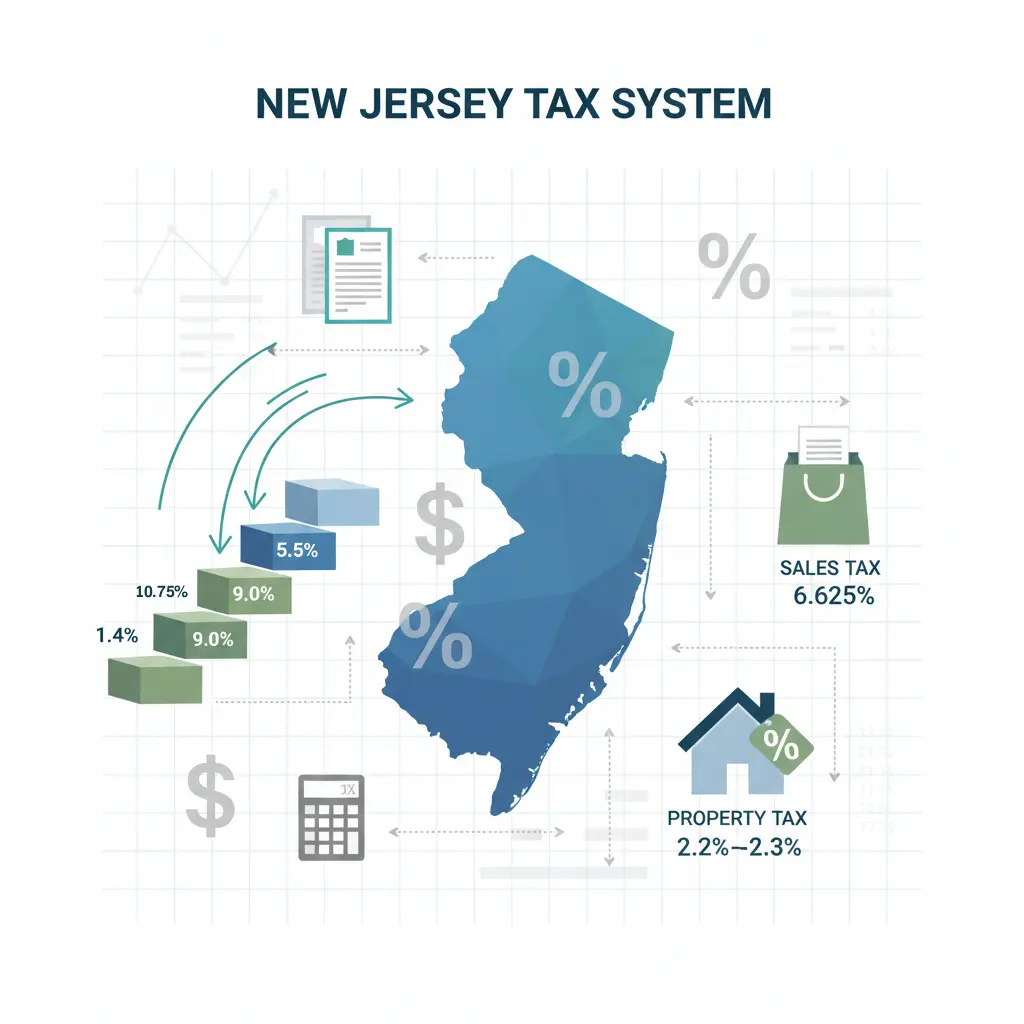
New Jersey operates one of the most complex and expensive tax systems in the United States. The state combines a progressive income tax ranging from 1.4% to 10.75%, a statewide sales tax of 6.625%, and the nation’s highest property tax burden, at roughly 2.2% to 2.3% of home value.
Understanding how each tax works helps New Jersey residents plan their finances more effectively. This guide breaks down every major tax type, explains how rates apply to your situation, and identifies programs that can reduce your burden.
Whether you currently live in New Jersey or you are considering a move to the state, knowing exactly what you will pay makes a substantial difference in your financial planning.
How Does New Jersey Income Tax Work?
New Jersey taxes individual income using a graduated income tax system with seven distinct brackets. Tax rates start at 1.4% for the lowest earners and climb to 10.75% for income exceeding $1 million annually.
This graduated structure means you pay different rates on different portions of your taxable income. Your entire income is not taxed at a single flat rate.
Understanding the Seven New Jersey Tax Brackets
The New Jersey state income tax applies progressively across these income ranges for single filers:
| Taxable Income Range | Tax Rate | Bracket Type |
| $0 to $20,000 | 1.4% | Entry Level |
| $20,001 to $35,000 | 1.75% | Low Income |
| $35,001 to $40,000 | 3.5% | Lower Middle |
| $40,001 to $75,000 | 5.525% | Middle Income |
| $75,001 to $500,000 | 6.37% | Upper Middle |
| $500,001 to $1,000,000 | 8.97% | High Income |
| Over $1,000,000 | 10.75% | Top Earners |
What Is the Sales Tax Rate in New Jersey?
New Jersey charges a state-wide sales tax of 6.625% on most retail purchases of tangible goods and an expanding list of taxable services. This rate applies uniformly across all counties with no additional local sales tax allowed.
The absence of a local sales tax sets New Jersey apart from neighboring New York, where combined state and local rates can exceed 8.5% in New York City.
Major Sales Tax Exemptions in New Jersey
New Jersey law creates important exemptions that reduce the sales tax burden on essential purchases:
- Unprepared food and groceries carry zero sales tax
- Clothing and footwear are fully exempt from sales tax in New Jersey.
- Prescription medications and most over-the-counter drugs face no sales tax
- Residential heating fuels, including natural gas and electricity, are exempted
- Newspapers and magazines sold by subscription avoid the tax
These exemptions distinguish New Jersey from neighboring states. Pennsylvania exempts all clothing regardless of price. New York taxes clothing items over $110.00 but exempts those under that threshold, matching the New Jersey approach.
Urban Enterprise Zones: Reduced Sales Tax Areas
A designated area in an economically struggling city where shoppers pay half the normal sales tax, to encourage people to spend money there and help the local economy recover.
New Jersey designates certain economically distressed areas as Urban Enterprise Zones. Qualified businesses operating within these zones charge a reduced sales tax rate of 3.3125% instead of the standard 6.625%.
This half-rate policy aims to stimulate economic activity in struggling communities by making shopping more affordable. Cities including Camden, Newark, Trenton, and Paterson contain multiple Urban Enterprise Zones.
Shoppers can identify participating businesses by looking for official Urban Enterprise Zone signage. The reduced rate applies automatically at qualifying retailers.
Standard Rate Areas
Most of New Jersey charges the full 6.625% sales tax on taxable goods and services.
- Suburban shopping districts
- Most retail centers statewide
- Online purchases delivered in NJ
Urban Enterprise Zones
Designated economically distressed areas charge only 3.3125% at participating businesses.
- 32 zones across New Jersey
- Major cities, including Newark, Camden
- Qualified retailers display official signs
What Services Get Taxed in New Jersey?
New Jersey expanded its sales tax to cover numerous services in recent years. Taxable services now include:
- Storage and moving services
- Investigation and security services
- Information services, including credit reports
- Processing services for tangible personal property
- Parking and garage services
Professional services such as legal advice, accounting, and medical care remain exempt from New Jersey sales tax. Most motor vehicle repair services also avoid taxation.
Why Are New Jersey Property Taxes So High?
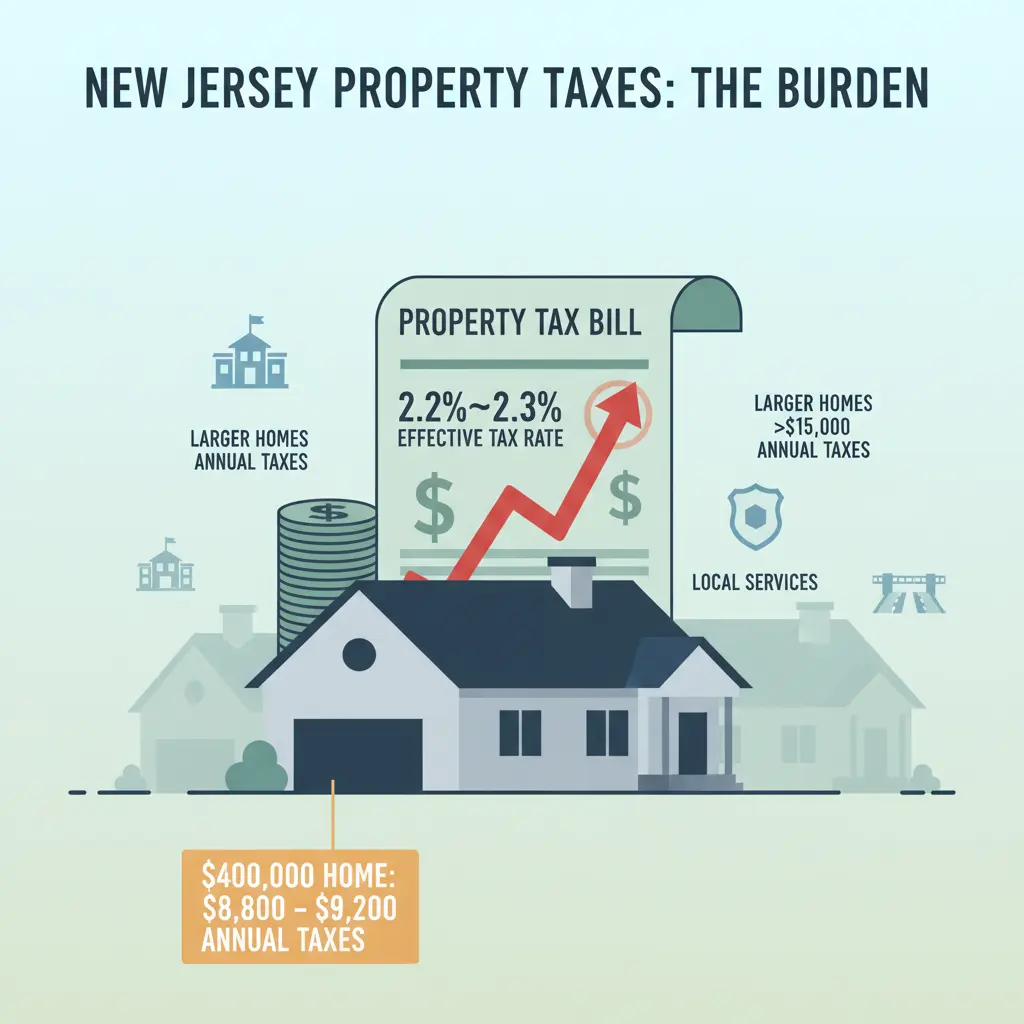
New Jersey property taxes represent the single largest tax burden most residents face. The state consistently ranks first nationally in property tax rates, with an average effective rate of 2.2% to 2.3% of assessed home value.
A homeowner with a $400,000 property typically pays between $8,800 and $9,200 in property taxes annually. In wealthy suburban counties, bills frequently exceed $15,000 per year.
Understanding Property Tax Components
New Jersey property taxes paid by homeowners get divided among three government levels:
School Districts
Public school funding accounts for the largest share of property tax bills, typically exceeding 50% of total property tax collections.
Municipal Government
Local town and city services, including police, fire, public works, and administration, draw the second-largest share.
County Government
County-level services such as courts, jails, parks, and health services account for the smallest share of property tax revenue.
This multi-layered structure creates massive variation across New Jersey. Bergen County and Morris County municipalities often levy the highest property taxes in the state. South Jersey counties typically charge lower rates but still exceed the national average.
Why New Jersey Property Taxes Run So High
Several structural factors drive New Jersey property tax rates far above those of other states:
- Heavy reliance on local property taxes instead of state funding for schools
- 565 separate municipalities, each maintaining independent services
- The high cost of living translates to expensive public employee salaries and benefits
- Strong public employee unions negotiate favorable pension and healthcare packages
- Constitutional requirements for school funding adequacy
- Geographic density requires extensive infrastructure maintenance
New Jersey funds education primarily through local property taxes rather than state income tax revenue. This approach creates enormous disparities between wealthy and poor districts.
Geographic Variation Across New Jersey
Property tax rates vary dramatically depending on location within New Jersey:
| County Area | Typical Annual Bill | Effective Rate Range |
| Bergen County | $12,000 – $18,000 | 2.4% – 2.8% |
| Morris County | $11,000 – $16,000 | 2.3% – 2.7% |
| Essex County | $10,000 – $15,000 | 2.5% – 3.0% |
| Middlesex County | $9,000 – $13,000 | 2.2% – 2.5% |
| Camden County | $6,500 – $9,500 | 1.9% – 2.3% |
| Atlantic County | $5,500 – $8,000 | 1.8% – 2.1% |
Wealthy suburban communities near New York City consistently carry the highest property tax burdens. South Jersey and shore communities typically charge lower rates but still rank above the national average.
Property Tax Relief Programs
New Jersey offers several programs designed to offset crushing property tax bills. Seniors and qualifying disabled residents can now apply for all applicable programs through a single combined application (Form PAS-1), available online or by paper mail.
ANCHOR Benefit Program
The Affordable New Jersey Communities for Homeowners and Renters program provides direct property tax relief through annual rebate payments. Eligible homeowners can receive up to $1,500 depending on income level.
Homeowners must meet income thresholds and property value limits to qualify. The benefit is issued as a direct check or credit rather than a reduction in the property tax bill.
Senior Freeze Program
Senior citizens who meet the age and income requirements can freeze their property tax bills at a base-year amount. Future increases get reimbursed through state payments.
Applicants must be 65 or older and meet income limits. The program protects fixed-income seniors from property tax increases they cannot afford.
Stay NJ Program
The Stay NJ program offers property tax benefits to eligible homeowners aged 65 and older, reimbursing 50% of their property tax bills up to a maximum benefit of $6,500. To qualify, applicants must have owned and lived in a home for the full year and have an income below $500,000.
The Stay NJ benefit is calculated after ANCHOR and Senior Freeze benefits are determined, effectively topping up whatever relief those programs already provide. Benefits are paid in quarterly installments rather than as a lump sum.
Veterans Property Tax Deduction
Qualifying veterans receive a $250 annual property tax deduction. Disabled veterans qualify for additional relief, up to full exemption, depending on their disability rating.
Combined Application (Form PAS-1)
For the first time in New Jersey’s history, seniors aged 65 or older and qualifying disabled homeowners can apply for all three state property tax relief programs, Senior Freeze, ANCHOR, and Stay NJ, by filling out a single application. The combined Form PAS-1 can be used by both homeowners and renters, and there are no longer separate ANCHOR-H or ANCHOR-T applications.
Does New Jersey Have an Inheritance Tax?
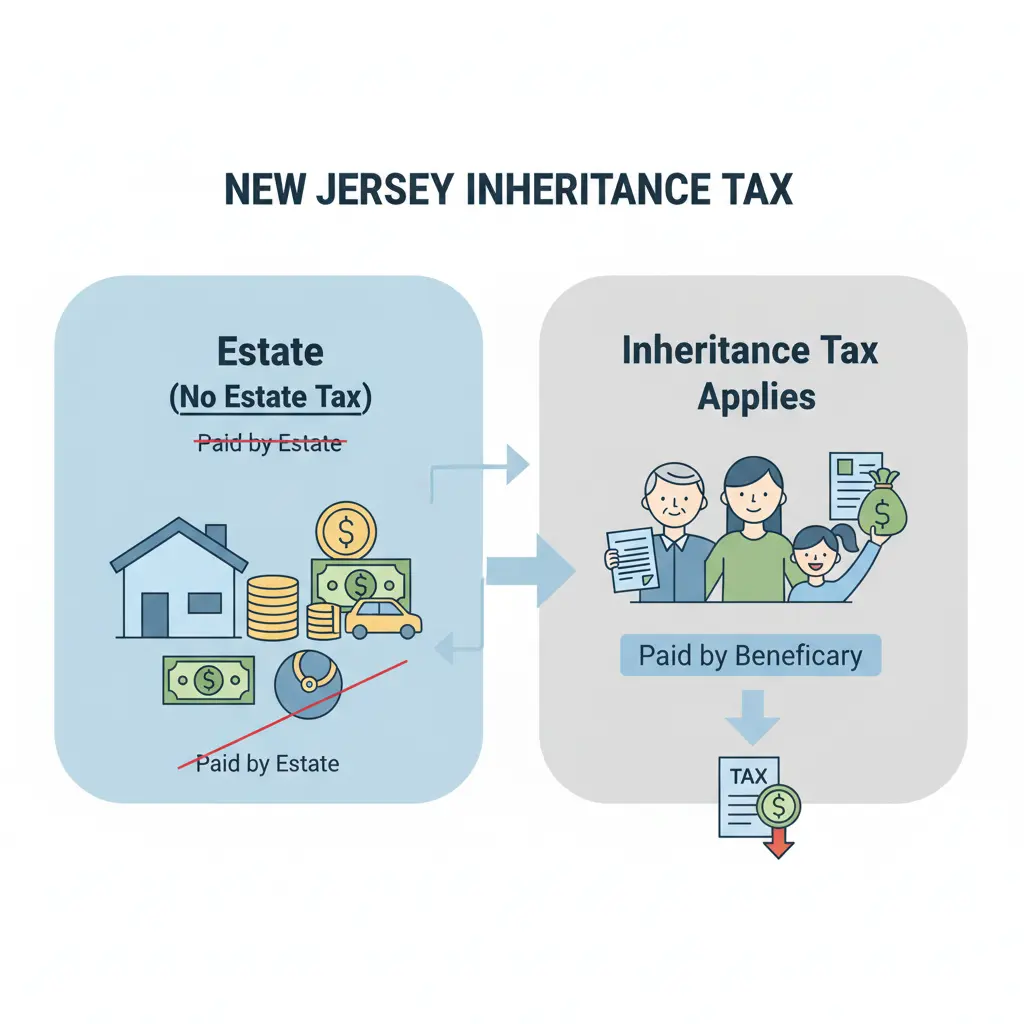
New Jersey eliminated its estate tax in 2018 but continues to enforce an inheritance tax on certain transfers of wealth. The state is one of only six states that maintains an inheritance tax.
The critical distinction: inheritance taxes are paid by the person receiving the inheritance, while estate taxes are paid by the deceased person’s estate before distribution.
Who Pays New Jersey Inheritance Tax?
The New Jersey inheritance tax does not apply to direct descendants. Spouses, children, grandchildren, and parents inherit completely tax-free.
The tax hits transfers to more distant relatives and unrelated individuals at rates between 11% and 16%:
Tax-Free Transfers
- Spouses and civil union partners
- Children and stepchildren
- Grandchildren and great-grandchildren
- Parents and grandparents
- Charitable organizations
Taxable Transfers
- Siblings (11% to 16%)
- Nieces and nephews (11% to 16%)
- Cousins (15% to 16%)
- Friends and unrelated persons (15% to 16%)
- Non-charitable organizations (15% to 16%)
New Jersey Inheritance Tax Rates
When inheritance tax applies, rates depend on the relationship between the deceased and the beneficiary, plus the amount inherited:
| Beneficiary Class | Tax Rate Range | Exemption Amount |
| Class A (Spouse, Parents, Children) | 0% | Fully Exempt |
| Class C (Siblings) | 11% – 16% | $25,000 |
| Class D (All Others) | 15% – 16% | None |
Siblings receive a $25,000 exemption before inheritance tax applies. The tax rate increases as the inherited amount rises, peaking at 16% for amounts over $1.7 million.
Conclusion: Final Thoughts on New Jersey Tax Rates
New Jersey has one of the highest tax jurisdictions in the United States. Residents pay state income taxes ranging from 1.4% to 10.75%, a 6.625% sales tax with limited exemptions, and property taxes averaging 2.2% to 2.3% of home value.
Property tax represents the single largest burden for most New Jersey homeowners. Bills frequently exceed $10,000 annually and reach $15,000 or more in wealthy suburban counties. The state also imposes an inheritance tax on transfers to siblings and non-relatives at rates ranging from 11% to 16%. Direct descendants inherit tax-free. Understanding exactly what New Jersey takes helps residents plan more effectively. Relief programs, including ANCHOR benefits and Senior Freeze, exist but require active application. Strategic tax planning can substantially reduce the burden. Whether New Jersey’s taxes represent a reasonable payment for excellent schools and services or an excessive burden that drives residents away remains hotly debated. The objective numbers show New Jersey consistently ranking among the highest-taxed states nationally.
Navigating New Jersey’s complex tax system doesn’t have to be a solo effort. The Chamberlain Accounting Firm offers a full range of tax and accounting services, including individual returns (1040), business returns (1065, 1120, 1120S), comprehensive bookkeeping, and specialized accounting for law firms. Proudly serving clients throughout Bergen County, New Jersey, and surrounding communities, as well as multiple states across the U.S., our team is equipped to handle your unique financial needs with precision and care. Ready to take control of your taxes? Reach out to us online or call (201) 371-3344 today for personalized, reliable guidance.
Disclaimer: This article is provided for general informational purposes only and does not constitute accounting, tax, or financial advice. The information contained herein is not intended to be relied upon for specific tax, accounting, or financial decisions, and may not reflect current tax law or guidance. No opinion expressed herein may be used for the purpose of avoiding penalties under federal, state, or local tax laws. Readers should consult with a qualified accounting or tax professional regarding their specific circumstances. This communication does not create an accountant-client or advisory relationship.