

In this Article
Picture a tenant in Buffalo holding an eviction notice. Or a worker in Queens owed three weeks of wages. Neither has a right to a free lawyer. In most civil cases, New York does not provide one.
About 4.1 million New Yorkers qualify for free civil legal help. One of the steadiest ways the state pays for it is IOLA. The money comes from interest on client funds that lawyers hold briefly. It costs taxpayers, lawyers, and clients nothing.
This guide covers how IOLA works and where the money goes. It also explains what lawyers and banks must do, and where the model is fragile.
What is IOLA?
IOLA is the Interest on Lawyers’ Trust Account Fund of the State of New York. It is a public fiduciary fund. The State Comptroller holds the money. A Board of Trustees decides how it is spent.
The Legislature created the fund in 1983, with strong backing from the New York State Bar Association. The timing mattered. Federal cuts had weakened civil legal services. Congress had just allowed interest on checking accounts. The Bar saw a chance: pool small deposits and send the interest to legal aid. Grants began in 1984.
Two statutes set the rules: State Finance Law §97-v and Judiciary Law §497.
- Board. The statute provides for 15 trustees appointed by the Governor. Legislative leaders and the Court of Appeals recommend most of them. At least eight must be New York attorneys. Terms run three years, without pay.
- Staff. About eleven full-time employees work in New York City. Christine Fecko is Executive Director.
- Payments. The Comptroller pays out only after the Board certifies. Administrative costs are capped at 10% of available funds, unless the Board votes to waive the cap.
How the money is generated
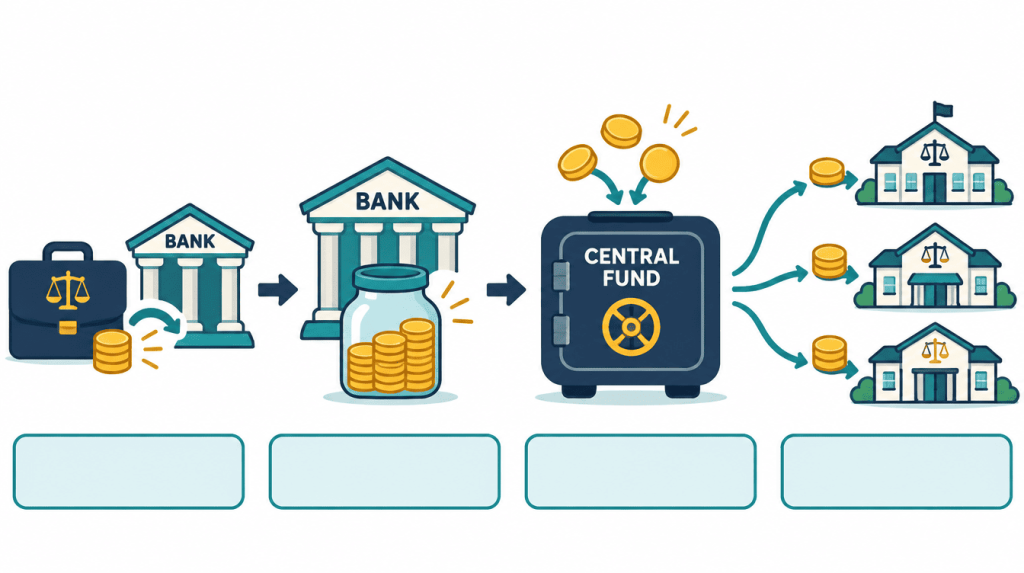
Lawyers often hold client money for a while. Think of a down payment before a closing, or a settlement check waiting to be split. Judiciary Law §497 gives the lawyer two options.
- Large or long-held funds go into a separate interest-bearing account in the client’s name. The client keeps the interest.
- Nominal or short-term funds are amounts “too small in amount or held for too short a time” to earn net interest for the client. These go into a pooled IOLA account.
Clients lose nothing here. On a small or brief deposit, bank fees and taxes would swallow any interest. Pooled across thousands of deposits, though, the interest adds up to real money.
The money then moves in four steps:
- A lawyer deposits qualified funds in an IOLA account at a participating bank.
- The bank pays interest on the pooled balance.
- The bank sends that interest to the IOLA Fund, at least quarterly.
- The Board awards it as grants to nonprofit legal aid providers.
💡 Pro Tip: The test is net interest for this client, not the dollar amount alone. A modest sum held for many months may deserve its own account. A large sum held for two days may not. Note your reasoning in the client file.
Why interest rates matter
Because IOLA lives on interest, its revenue tracks rates. When rates fell after 2002, grant funding shrank.
To protect revenue, banks must pay IOLA accounts at least what their best customers earn on comparable accounts. Or a bank can elect the “safe harbor” rate. That rate is the greater of 60% of the upper bound of the Federal Funds Target Rate, or 1.00%. It is recalculated on the first of each month.
Where the money goes
By law, at least 75% of each year’s funds go to civil legal services for the poor. That share is divided by where low-income people live across the state. The rest can support the administration of justice. That includes legal aid for older adults and people with disabilities, volunteer lawyer programs, and training.
The grant rules are strict:
- Eligible grantees: only not-for-profit, tax-exempt organizations.
- Eligible clients: generally people at or below 125% of the federal poverty level.
- Excluded work: criminal cases and habeas corpus challenges to criminal convictions. New York funds criminal defense through separate channels.
Most grants are general operating support. That lets providers aim money where demand is highest. In practice, that means housing, family, immigration, consumer, employment, and public benefits cases. These problems are tied to food, shelter, jobs, and health care.
The Justice Infrastructure Project
IOLA launched its Justice Infrastructure Project in December 2023. It pays for shared systems that no single provider could build alone.
In December 2025, the Board approved a one-time $4 million grant to Empire Justice Center, which will work with The Legal Aid Society under a subcontract. The grant will build a statewide training center for civil legal services staff. A statewide legal services directory and a shared knowledge platform are also in development.
Scale and impact
IOLA has awarded more than $750 million to civil legal services nonprofits since it began. Its FY2025 annual report shows the current scale.
| Measure (FY2025 unless noted) | Figure |
| Grants, FY2024 and FY2025 combined | $110 million |
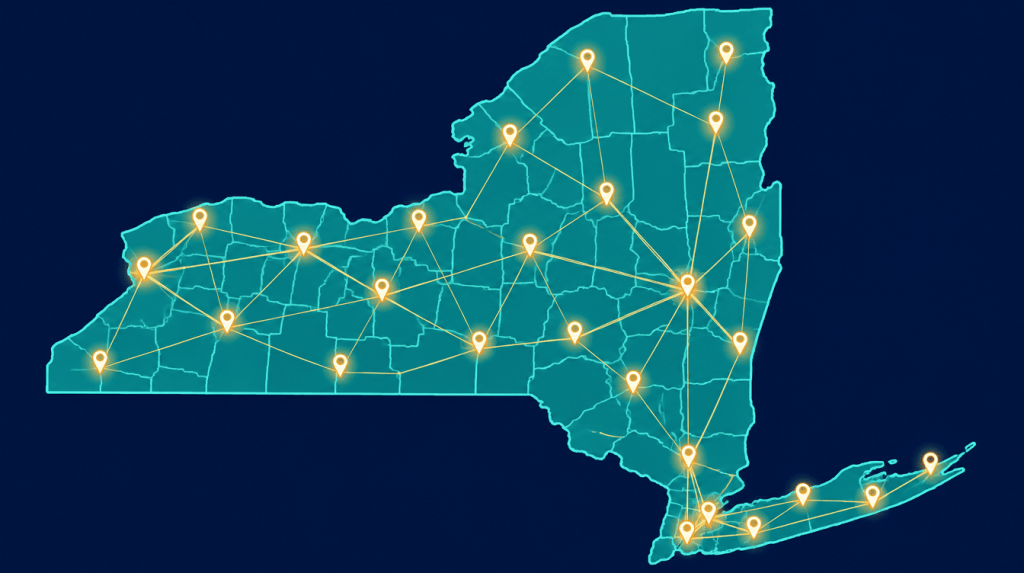
| Organizations funded | 80, covering all 62 counties |
| Cases closed by grantees | 336,789 |
| People who benefited | 691,846 |
| Estimated benefits and savings to the state | $5.47 billion |
| Planned grants, FY2026 to FY2030 contract cycle | Up to $562.5 million |
What lawyers and banks must do
IOLA works because participation is required. Lawyers and banks each have clear duties.
Lawyers
- Keep and use an IOLA account if you handle qualified funds.
- Never hold qualified funds in a non-interest-bearing account.
- Use a participating bank, and enroll the account with the IOLA Fund through the online Attorney Enrollment Form.
- Put larger or longer-held client money in a separate interest-bearing account for that client.
Banks
- Pay at least the comparable rate, or the safe harbor rate.
- Send the interest directly to the IOLA Fund at least quarterly.
Some banks go further. Platinum Partner Banks pay at least the safe harbor rate. Gold Partner Banks pay the greater of 50% of the target rate’s upper bound, or 0.50%. IOLA also flags partner banks that waive fees. Banking with one is a simple way for a firm to send more money for legal aid.
The fund itself must keep records that identify attorneys and clients confidential.
Watch Out: Trust account rules carry ethics consequences. Check the current text of Judiciary Law §497, 21 NYCRR Part 7000, and IOLA’s own guidance. If a deposit is a close call, ask ethics counsel.
Where IOLA is Fragile
IOLA turns idle money into public value. No client gives anything up. No lawyer pays a fee. No taxpayer is charged. Over four decades, the fund has paid out more than three quarters of a billion dollars.
The model has two weak points. First, revenue rises and falls with interest rates. When rates drop, grants shrink. Second, IOLA money is not tax revenue, but the fund can still spend only what the state budget authorizes each year. If that authority comes in below what the Board approves, grantees face cuts.
Those risks are why steady participation matters. If you practice in New York, check that your IOLA account is enrolled, and think about using a partner bank. If you need civil legal help, IOLA grantees serve all 62 counties.
At The Chamberlain Accounting Firm, we regularly work with attorney trust and IOLA accounts. Every week, we check your reconciliations, client ledgers, and records against New York’s recordkeeping rules. We’ll flag any client funds that belong in a separate interest-bearing account, and we’ll tell you exactly where you stand. Contact us here or call us at (201) 371-3344.
Frequently Asked Questions
No. IOLA only collects interest on client funds that are too small or held too briefly to earn the client any net interest. On those deposits, bank fees and taxes would use up the interest anyway. IOLA pools them and puts the interest toward civil legal aid.
Look at whether the funds could earn net interest for that client, not just at the dollar amount. Nominal or short-term funds go into IOLA. Larger or longer-held funds go into a separate interest-bearing account in the client's name. For a close call, write down your reasoning in the client file and ask ethics counsel.
Generally, people at or below 125% of the federal poverty level, through nonprofit legal aid providers in all 62 New York counties. The grants cover civil matters such as housing, family, immigration, consumer, employment, and public benefits cases. Criminal cases are not covered.
Disclaimer: This article provides general trust accounting information and is not intended as individualized financial advice. State trust accounting rules may differ. Please consult your accountant regarding your specific situation.