
In this Article
Every fall, the same scene plays out in accounting offices: a corporation filed Form 7004 back in the spring, breathed a sigh of relief, and then let the extended deadline creep up while the books sat half reconciled. If that sounds familiar, you’re not behind yet, but you’re meant to use the extension period, not just wait it out.
A corporation that properly requested an extension gets more time to complete its Form 1120, the federal return C corporations use to report income, deductions, and tax liability. It does not, however, get more time to pay. Understanding that distinction, and using the extension window to actually clean up the return rather than rush it at the deadline, is what separates a smooth filing from a stressful one.
What Is Form 1120?
Form 1120 is the annual federal income tax return for C corporations. It reports gross receipts, cost of goods sold, business expenses, officer compensation, depreciation, interest expense, charitable contributions, taxable income, and the resulting federal tax liability. Depending on the corporation’s activities, additional schedules may be required.
Before reviewing anything else, confirm the entity is actually taxed as a C corporation. Filing Form 1120 for an entity that should have filed Form 1120-S or another return is a mistake that’s far more painful to unwind after the fact than to catch up front.
Does a Corporation Automatically Get an Extension?
No. A corporation must file Form 7004, Application for Automatic Extension of Time to File Certain Business Income Tax, Information, and Other Returns, by the original due date of the return, per IRS instructions. For most Form 1120 filers, that extension is six months, though certain fiscal-year corporations, including some with tax years ending June 30, follow different rules. You can generally file Form 7004 electronically for eligible returns.
Example: A Calendar-Year Corporation’s Extension Timeline
Consider a calendar-year C corporation with a tax year ending December 31, 2025. Its regular Form 1120 deadline is generally April 15, 2026. If the corporation properly files Form 7004, it receives an automatic six-month extension, pushing the filing deadline into October. That’s the window this article is written for.
An Extension Does Not Extend the Payment Deadline
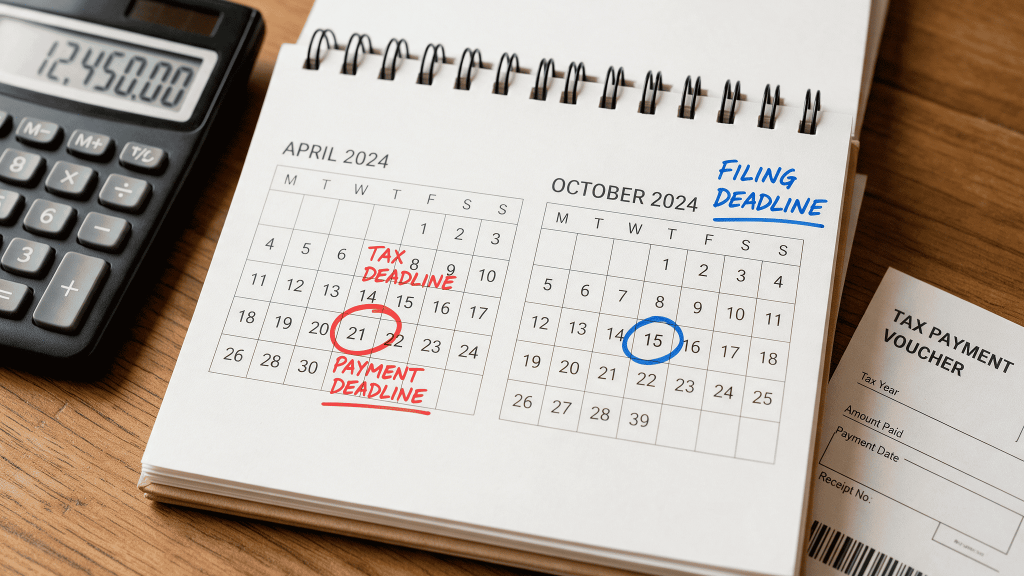
This is the point that trips up more business owners than any other. Form 7004 buys time to file. It does not buy time to pay.
The corporation should estimate its tax liability and pay the amount due by the original filing deadline. If you do not pay enough by that date, interest applies, and a late payment penalty may as well. The IRS generally provides relief from the late payment penalty when you pay at least 90% of the tax shown on the return by the original due date and pay the remaining balance by the extended due date, subject to applicable rules.
⚠️ Watch Out: “We filed an extension” does not mean “we can wait until October to pay.” Treat the original deadline as the payment deadline.
What Should You Gather Before Preparing Form 1120?
Extension season is the right time to make sure the corporation’s books are actually complete, not just close enough.
- Income and Revenue Records. Pull the year-end profit and loss statement, general ledger, sales records, invoices, 1099s received, interest and dividend statements, and any documentation of unusual or one-time transactions. Reconcile reported revenue against the accounting records rather than assuming the software got it right.
- Bank and Credit Card Statements. Reconcile every business account through year-end. Look for missing or duplicate transactions, unusual withdrawals, owner or shareholder transactions, transfers between accounts, personal expenses paid by the corporation, and unrecorded deposits.
- Fixed Assets and Depreciation. Review significant purchases: equipment, computers, furniture, machinery, vehicles, certain software, and building improvements. Tax treatment depends on the actual asset, the date placed in service, and business use, not simply the amount paid.
- Payroll and Officer Compensation. Reconcile W-2 wages, payroll reports, payroll tax returns, employer payroll taxes, officer compensation, and retirement plan contributions.
- Loans and Interest. Gather loan statements, year-end balances, interest paid, new borrowing, principal repayments, and related party loans. Interest expense may be limited depending on the circumstances.
Review the Corporate Balance Sheet

Never copy a corporation’s balance sheet straight from the accounting system without a second look. Review cash, accounts receivable, inventory, fixed assets, accumulated depreciation, accounts payable, credit cards, loans, accrued expenses, shareholder or related party accounts, common stock, additional paid-in capital, and retained earnings.
In practice, a large shareholder receivable or payable is one of the most common red flags on a first-year review. It usually needs its own explanation rather than a pass-through to the return unexamined.
Review the Prior-Year Form 1120
The prior-year return is a starting reference, not a template to copy. Compare it with current-year records and check carryforward items, depreciation schedules, net operating losses, tax credits, fixed assets, balance sheet accounts, and any unusual prior-year transactions.
Review Tax Adjustments
Financial statements and tax returns don’t always report income and expenses the same way. Common book-to-tax differences include depreciation, meals and entertainment limitations, nondeductible expenses, charitable contribution limitations, accrued expenses, state and local tax differences, and tax-exempt income. These typically flow through the corporation’s tax reconciliation schedules.
Don’t Forget State Corporate Tax Returns
The federal Form 1120 is only part of the picture. A corporation may also owe state corporate income or franchise tax based on where it does business, owns property, or has employees. A federal extension does not automatically extend every applicable state deadline; you need to review state requirements separately.
What If the Corporation Still Doesn’t Have All Its Records?
Don’t wait until the final days before the extended deadline to discover a gap. Build a missing information list: bank statements, credit card statements, unreconciled accounts, fixed asset invoices, loan statements, payroll reports, 1099s, unclear shareholder transactions, unexplained balance sheet accounts, or missing state information. Then follow up with the business owner early. This is exactly what the extension period is for: resolving questions instead of rushing past them.
What Happens If the Corporation Misses the Extended Deadline?
An extension isn’t an unlimited postponement. A return filed after the extended due date can be subject to a late filing penalty unless an exception such as reasonable cause applies, and interest continues to accrue on unpaid tax in the meantime. Treat the extended deadline as a finish line, not a starting point for preparation.
A Practical Extension-Season Checklist
| Area | What to Review |
| Entity | Confirm C corporation status |
| Extension | Confirm Form 7004 was timely filed |
| Income | Reconcile revenue and other income |
| Banking | Complete bank reconciliations |
| Credit Cards | Reconcile all business cards |
| Payroll | Reconcile wages and payroll taxes |
| Fixed Assets | Review purchases and depreciation |
| Loans | Reconcile principal and interest |
| Balance Sheet | Investigate unusual balances |
| Prior Year | Review carryforwards and prior year items |
| Book to Tax | Identify applicable adjustments |
| State | Review state filing and payment requirements |
| Tax Payments | Confirm estimated and extension payments were applied correctly |
| Final Review | Review the completed return before filing |
Conclusion
Extension season isn’t just extra time to file. It’s a chance to clean up the books, resolve missing information, verify depreciation, reconcile the balance sheet, and prepare a return that’s actually complete rather than merely on time.
The one rule worth repeating: a federal extension gives you more time to file, not more time to pay. Form 7004 must be filed by the original due date, and the corporation’s estimated tax liability should be addressed by that same date.
If your corporation received an extension for its Form 1120, use the time. Starting early reduces the odds of finding a significant problem three days before the deadline. At The Chamberlain Accounting Firm, we help businesses with bookkeeping, accounting, corporate tax preparation, and tax planning. We can help business owners organize their financial information and prepare for their federal and state tax filing requirements. Contact us or call us at (201) 371-3344.
Frequently Asked Questions
No. Form 7004 only extends the filing deadline, generally by six months. The corporation's estimated tax liability is still due by the original filing deadline, and unpaid amounts can accrue interest and penalties.
For a corporation with a December 31 year-end, the original deadline is generally April 15, and a timely filed Form 7004 pushes the filing deadline into October, six months later.
Not automatically. States set their own filing and payment rules, so corporations need to check state requirements separately rather than assuming the federal extension applies everywhere they operate.
Disclaimer: This article provides general federal tax information and is not intended as individualized tax advice. State tax rules may differ. Please consult your tax professional regarding your specific situation.